Demetra product
SDLC Intelligence Platform
Coordinated AI agents across your software development lifecycle
An agentic software engineering platform that orchestrates specialised AI agents across architecture analysis, code generation, code and PR review, testing and delivery — integrated with your repositories, tools and engineering standards.
The problem: capable assistants, fragmented lifecycle
Most engineering organisations now use AI coding tools — as isolated assistants. Each developer prompts alone, review quality depends on who is reviewing, multi-step work moves between tools through manual handoffs, and nothing that works is captured as a reusable, governed capability. The result is local productivity without lifecycle-level improvement.
- Fragmented AI tools that do not share context or standards
- Isolated assistants with no coordination across lifecycle stages
- Inconsistent engineering practices across teams and repositories
- Manual handoffs between analysis, implementation, review and testing
- No reusable, governed capabilities the organisation actually owns
What the platform is
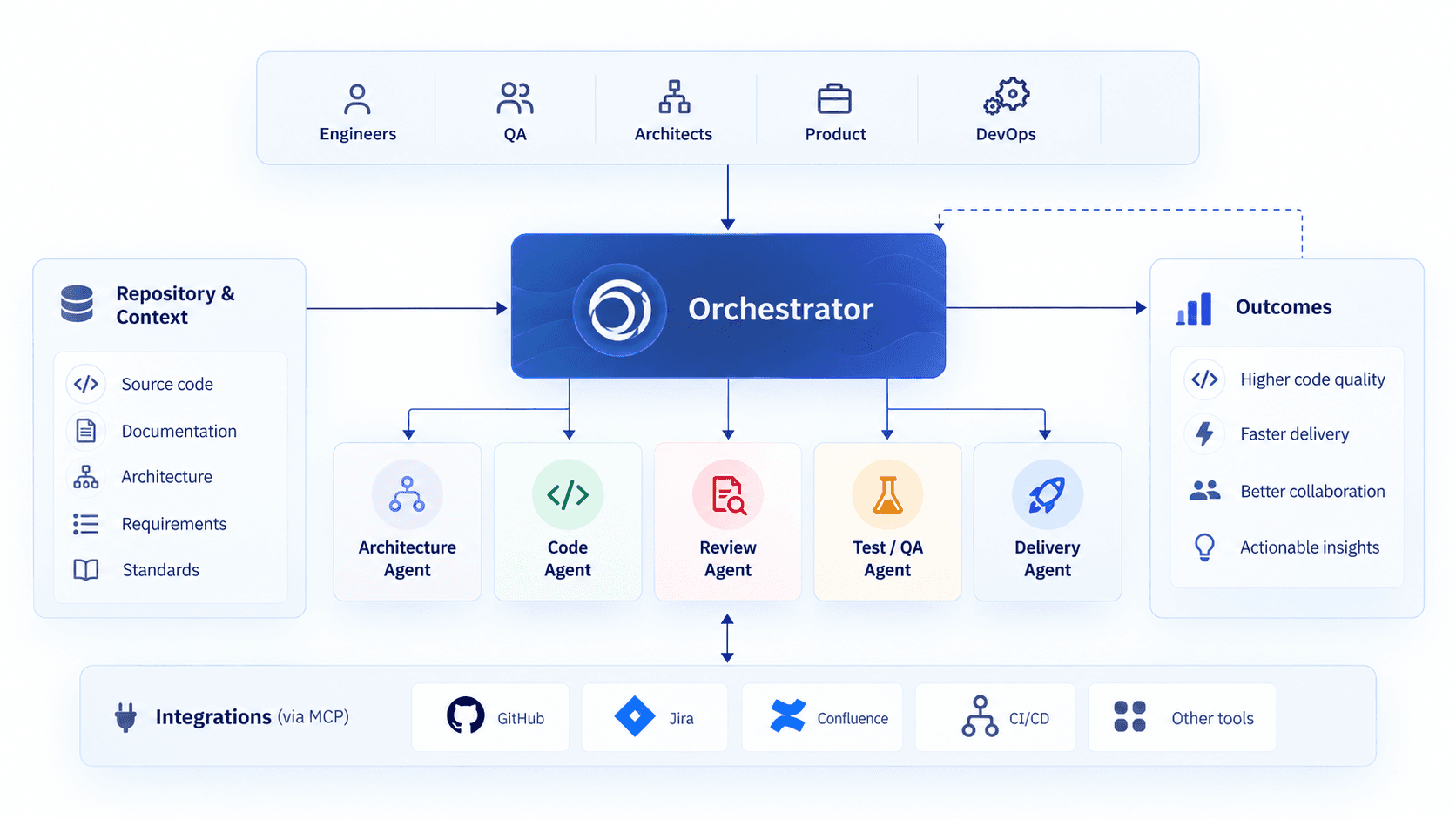
SDLC Intelligence Platform is built around an orchestrator that coordinates specialised agents and subagents — rather than a single generic coding assistant. Agents work with repository- and architecture-level context, reach your engineering tools through MCP and managed integrations, and execute multi-step workflows with defined boundaries and review points.
Lifecycle coverage
The platform covers the development lifecycle end to end. Capabilities are adopted per stage — organisations typically start where the pressure is highest and extend from there.
Architecture & repository analysis
Agents build a structural understanding of your repositories — components, dependencies, conventions and risks — and produce evidence-cited architecture documentation and assessments.
Implementation
Multi-step implementation work executed by coordinated agents against your codebase and standards, from scoped changes to larger migrations — with human review at defined points.
Code & PR review
Structured review of pull requests by specialised review agents: correctness, security-relevant patterns, conventions and test coverage, returned as actionable inline feedback.
Testing & quality controls
Test generation and QA workflows that exercise real behaviour, plus quality gates that keep agent-produced changes within your engineering standards.
Delivery & feedback
Integration with CI/CD and issue tracking closes the loop: delivery outcomes feed back into the repository context agents work from.
What it can automate
Evidence-cited architecture documentation
Generate and maintain architecture documentation from the actual code — cited, current and reviewable — instead of slideware that drifts.
Multi-agent PR review
Every pull request reviewed by parallel specialist agents, with findings verified before they reach the developer as inline comments.
Repository-aware implementation
Scoped features, refactorings and migration steps executed against your conventions, with tests, and handed over as reviewable pull requests.
Test generation & QA harnesses
Behaviour-exercising tests and repeatable QA workflows generated for existing code, raising coverage where it matters.
Reusable engineering capabilities
Working practices packaged as versioned capabilities — review checklists, workflow skills, agent rosters — distributed and updated centrally.
Workflow automation across tools
Multi-step workflows that span repositories, tickets and documentation — from ticket to reviewed change — with approval boundaries where actions matter.
Fits your engineering environment
The platform connects to engineering tools through the Model Context Protocol (MCP) and managed integrations — GitHub for repositories and pull requests, Jira for issue tracking, Confluence for documentation, and CI/CD pipelines. Integration coverage is confirmed against your actual toolchain during evaluation.
- GitHub
- Jira
- Confluence
- CI/CD pipelines
- MCP servers
- Internal APIs
Adapted to your SDLC, not the other way round
Workflows, agents, policies, prompts, integrations and capability packs are configured and extended to your development lifecycle, repositories, coding standards and governance requirements. Your review gates, branching model and quality bars stay authoritative — the platform enforces them rather than replacing them.
Deployment & operating model
Designed for your engineering environment
SDLC Intelligence Platform is deployed and configured around your repositories, development tools, security model and engineering workflows. Depending on enterprise requirements, capabilities can run within a customer-controlled environment or through a managed deployment model. Integrations, agents and workflows are adapted to the organisation’s SDLC and governance requirements.
Exact hosting and deployment choices are engagement-dependent and confirmed during an architecture and discovery phase.
What a working lifecycle looks like
A concrete example — the pull-request review workflow. The same orchestration pattern drives architecture analysis, implementation and testing workflows.
Pull-request review, orchestrated
- A pull request is opened; the orchestrator scopes the diff and selects specialist review agents.
- Parallel agents review correctness, conventions, security-relevant patterns and test coverage.
- Findings are cross-verified; weak or duplicate findings are discarded.
- Verified findings arrive as inline PR comments with concrete fix suggestions.
- The team’s review standards are updated as versioned capabilities — the next review starts smarter.
Evaluate it against your lifecycle
The right starting point depends on your environment, integrations and where your lifecycle loses the most time. Bring a concrete use case — a review bottleneck, a documentation gap, a migration — and we will walk through how the platform would handle it in your context.