AI as a governed organisational capability.
For many organisations, model access is no longer the hard part — capability architecture is. AI adoption often begins with local tools and experiments; the difficult part is turning the useful ones into shared, secured and operable organisational capabilities. We design and build that layer: governed agents, custom MCP servers, reusable skills and controlled distribution, embedded into real business and engineering workflows.
The organisational AI problem
Successful local experiments create a second-order problem: ownership, permissions, versioning, rollout, audit and lifecycle management. Without a common architecture, duplication, uncontrolled access to internal systems and unmanaged versions follow — and each new experiment adds to the pile rather than to a managed capability set.
Capability architecture
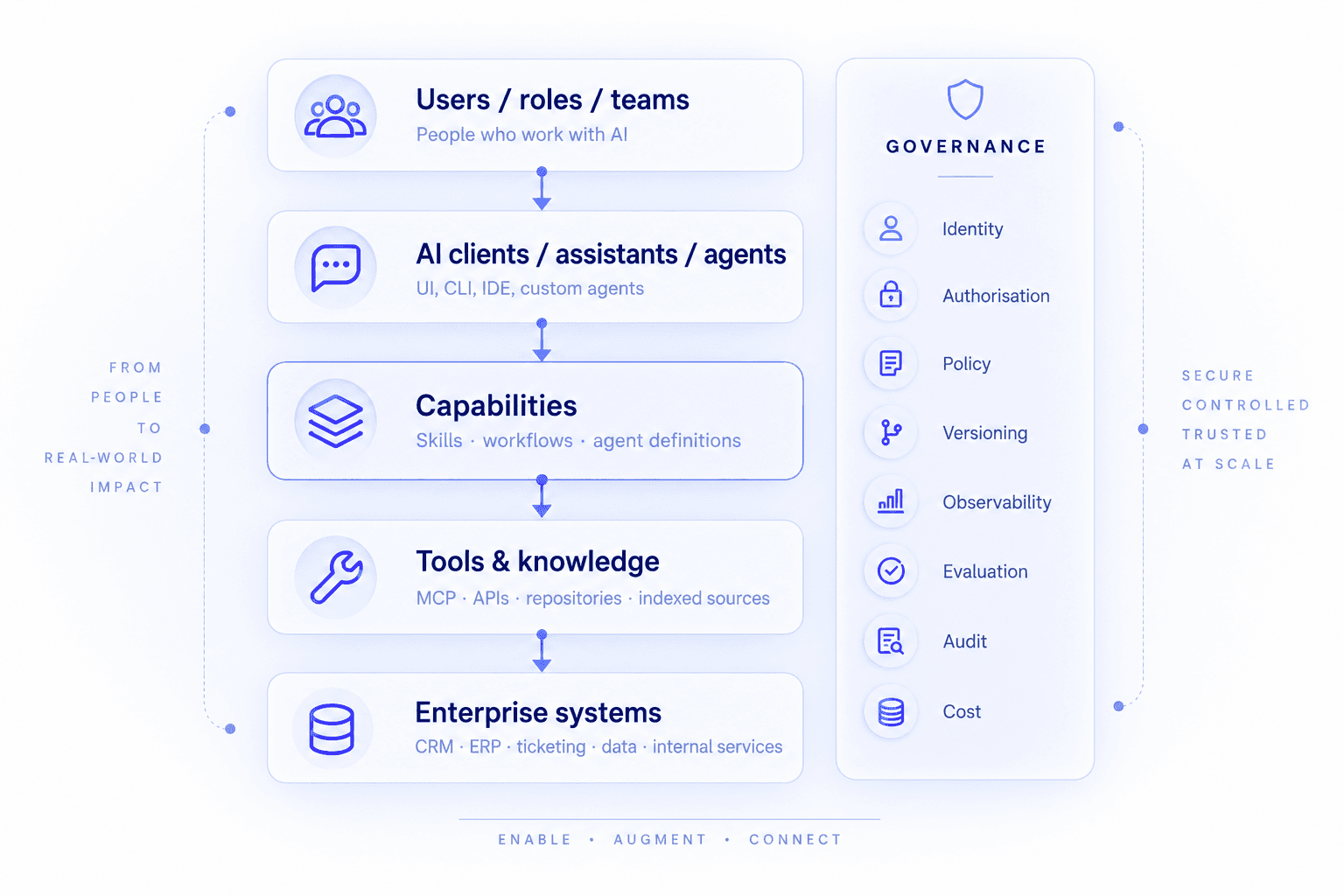
AI value reaches users through a capability layer the organisation defines, and reaches systems through an integration layer the organisation controls — with governance as a layer of its own rather than an afterthought bolted onto each experiment. The architecture is vendor-neutral; MCP, skills and agent frameworks are implementation mechanisms used where they provide useful technical boundaries.
Agentic systems
An agent is a bounded executor for a defined job — useful exactly to the degree its tools, knowledge and stopping conditions are defined. We design agentic systems with explicit boundaries and evaluation criteria, and with human approval kept mandatory where actions are irreversible, externally visible or financially significant.
MCP and enterprise tool integration
MCP can expose approved tools and resources through standardised interfaces; whether those interfaces are actually governed depends on the identity, authorisation, policy, deployment and audit model around them. We design and implement MCP servers where they provide a useful boundary between AI clients and internal systems — for internal APIs, repositories, knowledge systems and enterprise applications, with agents authenticating as managed identities under least privilege.
Skills and capability distribution
Where the client platform supports reusable skills or capability packages, we treat them as owned and versioned assets rather than private prompt collections. Capabilities are packaged, versioned, owned and distributed through controlled channels — different roles or teams can receive different capability sets, while updates and deprecation remain centrally manageable.
Governance and lifecycle
Identity, permissions, policy, tenant boundaries, versioning, audit and observability form a layer of their own. Role, team and client boundaries are expressed as configuration rather than discipline; permissions are enforced at the tool and retrieval boundary; and an agent counts as production-ready only when the organisation can see what it does, measure whether it works and afford what it costs.
AI in engineering workflows
Engineering organisations are the natural first adopters — the work is text-heavy, tool-rich and already versioned. We build governed capabilities for code review, documentation, migration analysis and test scaffolding, with agents wired to repositories, CI and issue tracking through managed integrations. Demetra applies this to itself: our own delivery runs on the capability architecture described here.
AI in business workflows
The unit of integration is the process step, not the chatbot: intake triage, document preparation, classification, enrichment, routing, drafting-for-review. Each automated step keeps an owner, an approval boundary and an audit trail, and connects to the systems where the process actually lives. Modest, governed automation of a real process outperforms an impressive demo of an imaginary one.
Demetra platform · In development
We are developing the same class of organisational infrastructure ourselves: corporate identity, permission-aware knowledge access, controlled integrations, agents, metrics and audit.
Typical outputs
- Capability-architecture assessment of the current AI landscape
- Target architecture across capability, tool and governance layers
- Custom MCP server implementations
- Agent and workflow implementations with approval points
- Capability catalogue and distribution mechanics
- Policy and permission model
- Governance and evaluation framework
- Rollout and lifecycle plan