Production-oriented AI and knowledge systems.
Most AI initiatives don't fail in the demo. They fail against production constraints — retrieval quality, evaluation, permissions, latency, cost, and integration with the systems where work actually happens. We design and build AI and knowledge systems for that standard: grounded in your data, measured against defined criteria, and operable inside your existing applications and processes.
When organisations call us
- AI experiments exist across the organisation, but none of them are production-ready.
- Internal knowledge is fragmented across wikis, drives, tickets and specialist knowledge held by individuals — and none of it is reliably findable.
- Teams need grounded, permission-aware access to complex information, with sources they can check.
- AI needs to reason over internal data, documentation or domain knowledge — not general internet text.
- Retrieval quality, evaluation and traceability are unresolved, so output quality and traceability are not yet sufficient for operational use.
- A prototype works in demos and falls apart against real data, real users and real constraints.
What we do
- AI opportunity and feasibility assessment against your actual data, systems and constraints.
- LLM application architecture — model choice, context design, integration points, failure modes.
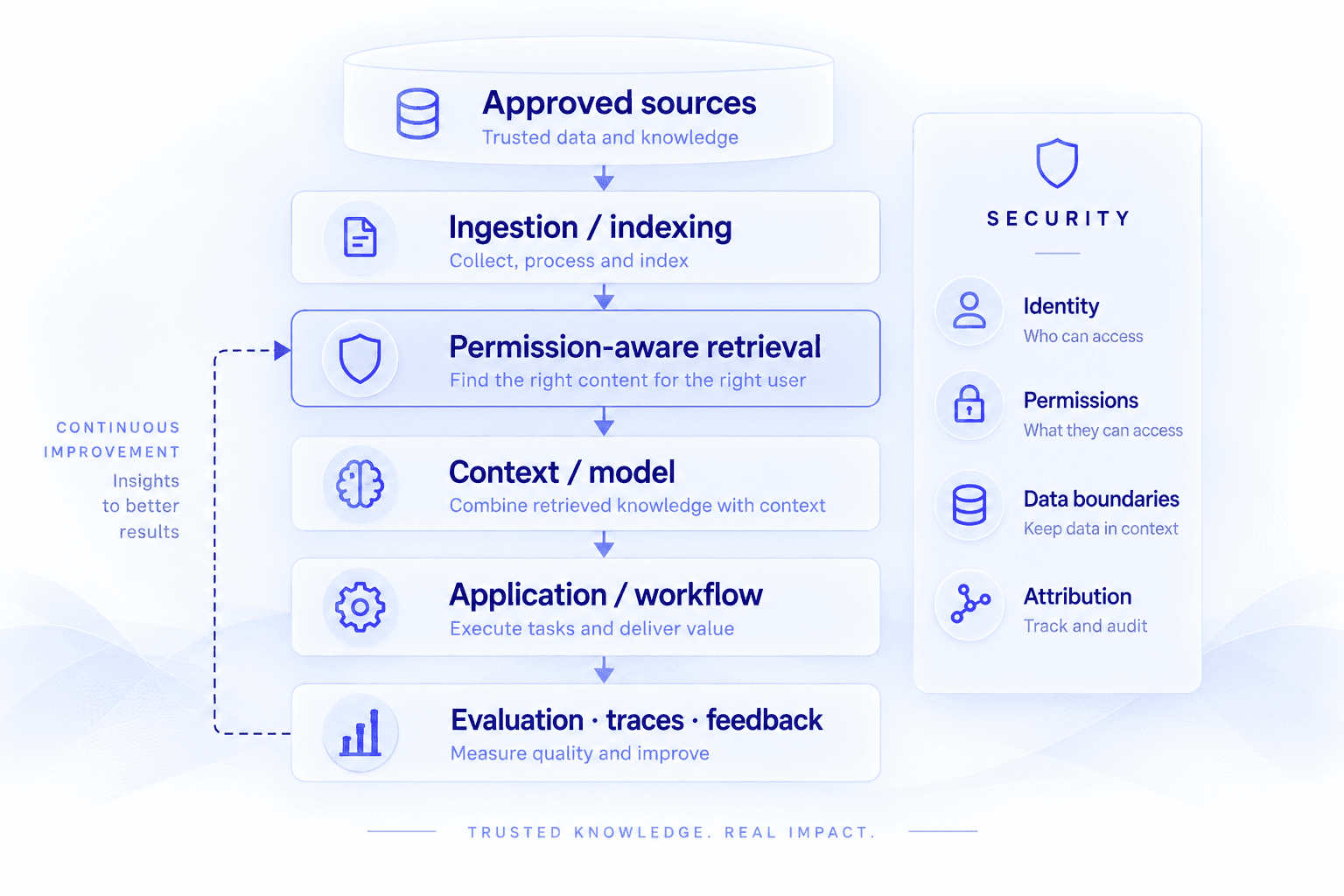
- Retrieval and knowledge systems: ingestion from approved sources, indexing, semantic and hybrid search, access-aware retrieval with source attribution.
- RAG and grounding design, so answers trace to what your organisation knows.
- Evaluation frameworks: defined success criteria, measured before and after every change — not anecdotes.
- Guardrails and observability: what the system may do, and visibility into what it actually did.
- Prototype-to-production engineering, including integration with existing applications and processes.
Typical outputs
- Feasibility assessment with a clear go/no-go rationale
- LLM application architecture
- Retrieval/knowledge-system design and implementation
- Evaluation framework with baseline measurements
- Grounding and context architecture
- Guardrail and observability setup
- Production integration plan
- Reference implementation
How we approach it
Applied AI is an engineering discipline: we treat models as components with failure modes, not magic. Evaluation criteria are defined before the feature set expands; retrieval is designed around your data and permissions; and production operation — monitoring, cost, change management — is part of the design, not an afterthought.