Controlled evolution of critical systems.
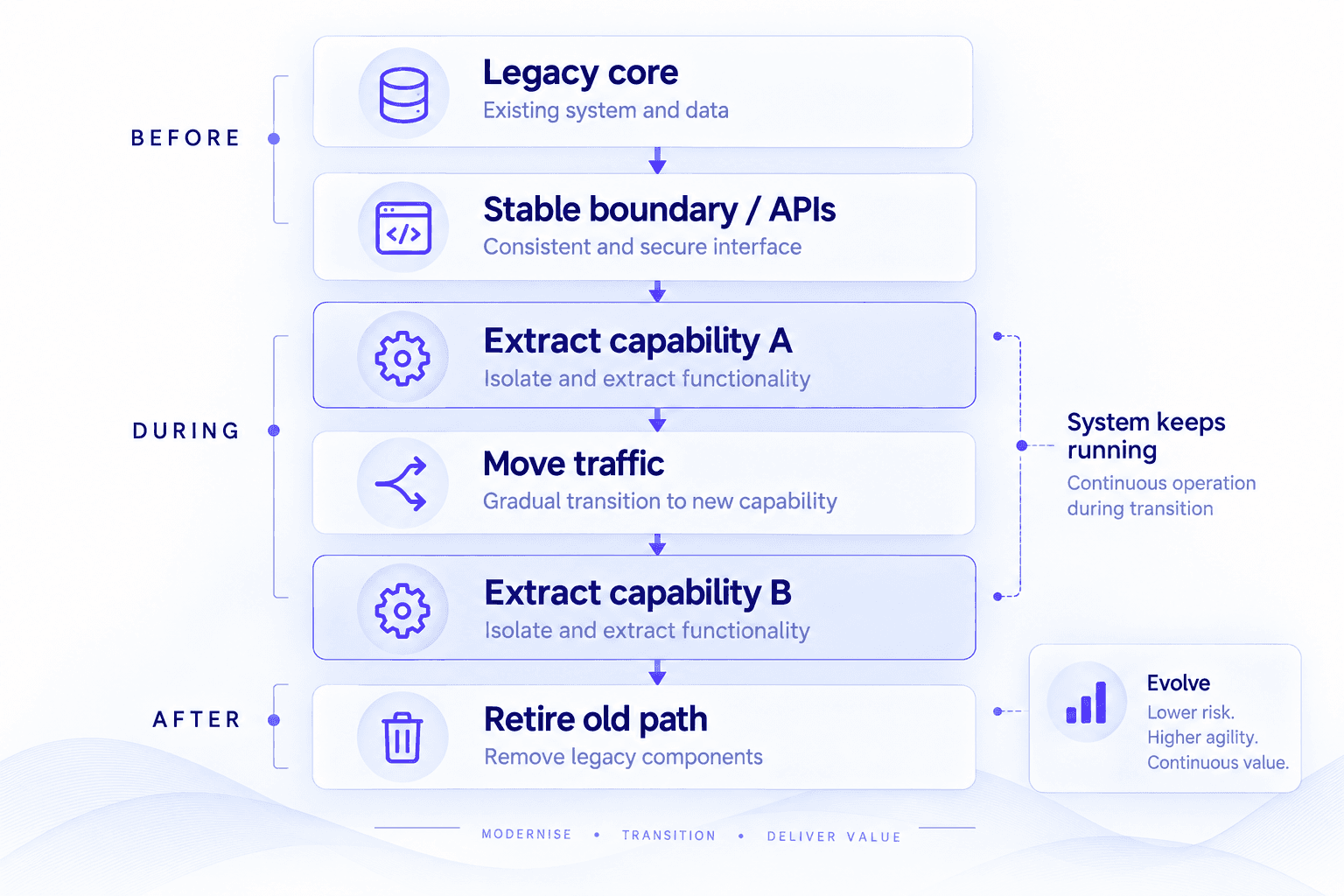
The systems that matter most are usually the hardest to change — and the ones nobody can afford to switch off for a rewrite. We modernise critical systems incrementally: assessing what exists, reducing coupling and risk, and sequencing change so the platform keeps running while its architecture, technology and operability improve underneath it.
When organisations call us
- Critical systems have become difficult and risky to change.
- Legacy technology blocks capabilities the business now needs.
- Replacing the existing platform outright is not an option — operationally or financially.
- Architecture has accumulated coupling that turns every small change into a large one.
- A cloud or platform migration is under consideration and the sequencing is unclear.
What we do
- Legacy assessment: structure, dependencies, operational risk and what actually blocks change.
- Modernisation strategy with incremental, strangler-style replacement approaches.
- Modularisation and dependency reduction to make future change cheaper.
- API enablement so existing systems can participate in new capabilities.
- Migration architecture and production migration planning, including cloud readiness.
- Technical debt prioritisation tied to delivery and operational impact.
Typical outputs
- Legacy assessment report
- Modernisation strategy and engineering roadmap
- Target architecture with incremental migration path
- Modularisation and API-enablement plan
- Dependency and risk reduction plan
- Cloud-readiness assessment
- Production migration plan
How we approach it
We default to incremental modernisation unless replacement is justified by evidence. Modernisation is sequenced as a series of production-safe steps, each one leaving the system better and still running — with the order chosen by risk and delivery impact, and progress measured by what got easier to change.